Prayer

A Humble Prayer

True learning goes beyond books; it begins with a sense of peace and a heart filled with gratitude. As we walk together on the path of knowledge and personal growth, let us also nurture our inner calm.

Please chant:

Hare Krishna Hare Krishna
Krishna Krishna Hare Hare
Hare Rama Hare Rama
Rama Rama Hare Hare

May these sacred words bring harmony.

๐Ÿ™๐Ÿฝ Thank you

Showing posts with label (025) NCERT-10-8-Introduction to Trigonometry. Show all posts

Tuesday, June 11, 2024

176-NCERT-10-8-Introduction to Trigonometry - Ex- 8.3

NCERT
10th Mathematics
Exercise 8.3
Topic: 8 Introduction to Trigonometry

Do you need help with math? We're here to help you! We have everything you need, including textbooks from NCERT, trigonometry lessons, and more. Join our online community and get the help you need.


EXERCISE 8.3

Q 1. Express the trigonometric ratios sin A, sec A, and tan A in terms of cot A.

Solution:

Ans:
Q 3. Choose the correct option. Justify your choice.
(i) 9 sec2 A – 9 tan2 A =
(A) 1 (B) 9 (C) 8 (D) 0
(ii) (1 + tan ฮธ + sec ฮธ) (1 + cot ฮธ – cosec ฮธ) =
(A) 0 (B) 1 (C) 2 (D) –1
(iii) (sec A + tan A) (1 – sin A) =
(A) sec A (B) sin A (C) cosec A (D) cos A
(iv) [1 + tan2 A] / [1 + cot2 A] =
(A)  sec2 A (B) –1 (C) cot2 A (D) tan2 A

Solution:

Ans:


Solution:

Ans:


#mathhelp #NCERT #studentsuccess #Trigonometry #education #learning #students #teachers #math

Saturday, June 8, 2024

175-NCERT-10-8-Introduction to Trigonometry - Ex- 8.2

NCERT
10th Mathematics
Exercise 8.2
Topic: 8 Introduction to Trigonometry

We're here to help you with math! Our resources include NCERT textbooks, lessons on Introduction to Trigonometry, and more. Join our community of students and teachers today!

Click here for ⇨ NCERT-10-8-Introduction to Trigonometry - Ex- 8.1

EXERCISE 8.2

Q 1. Evaluate the following :
(i) sin 60° cos 30° + sin 30° cos 60°
(ii) 2 tan2 45° + cos2 30° – sin2 60°
(iii) [cos 45°] / [sec 30° + cosec 30°]
(iv) [sin 30° + tan 45° – cosec 60°] / [sec 30° + cos 60° + cot 45°]
(v)  [5 cos2 60° + 4 sec2 30° – tan2 45°] / [sin2 30° + cos2 30°]

Solution:

(i) sin 60° cos 30° + sin 30° cos 60°

1) Using the above table,

a) sin 60° = √3/2,
b) cos 30° = √3/2,
c) sin 30° = 1/2
d) cos 60° = 1/2
our expression = sin 60° cos 30° + sin 30° cos 60°
our expression = (√3/2) (√3/2) + (1/2) (1/2)
our expression = (3/4) + (1/4)
our expression = (3 + 1)/4
our expression = 4/4
our expression = 1
2) So, sin 60° cos 30° + sin 30° cos 60° = 1.

(ii) 2 tan2 45° + cos2 30° – sin2 60°

1) Using the above table,

a) tan 45° = 1,
b) cos 30° = √3/2,
c) sin 60° = √3/2
our expression = 2 tan2 45° + cos2 30° – sin2 60°
our expression = 2(1)2 + (√3/2)2 – (√3/2)2
our expression = 2(1) + (3/4) – (3/4)
our expression = 2 + 0
our expression  = 2
2) So, 2 tan2 45° + cos2 30° – sin2 60° = 2.

(iii) [cos 45°] / [sec 30° + cosec 30°]

1) Using the above table,
a) cos 45° = 1/√2,
b) sec 30° = 2/√3,
c) cosec 30° = 2, 

2) So, [cos 45°] / [sec 30° + cosec 30°] = (3√2 – √6) / 8.


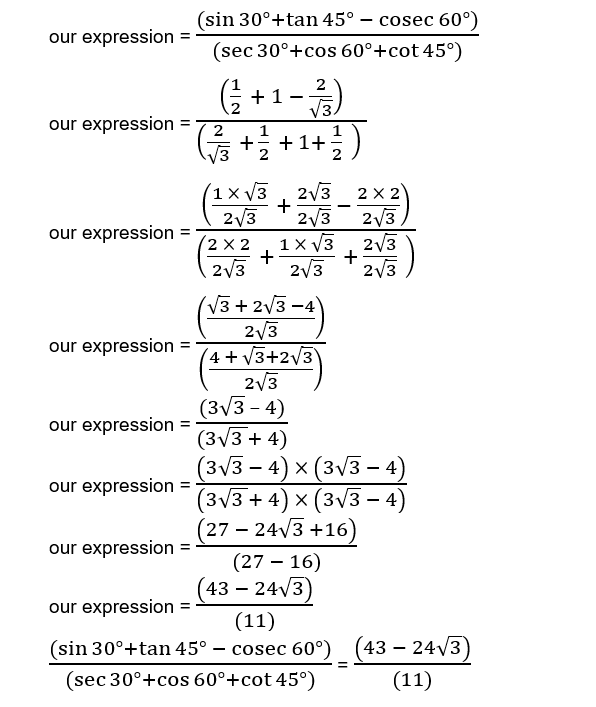
(iv) [sin 30° + tan 45° – cosec 60°] / [sec 30° + cos 60° + cot 45°]

1) Using the above table,
a) sin 30° = 1/2,
b) tan 45° = 1,
c) cosec 60° = 2/√3,
d) sec 30° = 2/√3,
e) cos 60° = 1/2,
f) cot 45° = 1,

(v)  [5 cos2 60° + 4 sec2 30° – tan2 45°] / [sin2 30° + cos2 30°]

1) Using the above table,
a) cos 60° = 1/2,
b) sec 30° = 2/√3,
c) tan 45° = 1,
d) sin 30° = 1/2, 
e) cos 30° = √3/2,


Q 2. Choose the correct option and justify your choice :

(i) 2tan 30°/1+tan230° =

(A) sin 60°            (B) cos 60°          (C) tan 60°            (D) sin 30°

(ii) 1-tan245°/1+tan245° =

(A) tan 90°            (B) 1                    (C) sin 45°            (D) 0

(iii)  sin 2A = 2 sin A is true when A =

(A) 0°                   (B) 30°                  (C) 45°                 (D) 60°

(iv) 2tan30°/1-tan230° =

(A) cos 60°          (B) sin 60°             (C) tan 60°           (D) sin 30°

Solution:


(i) 2tan 30°/1+tan230° 

1) Using the above table,
a) tan 30° = 1/√3,

(ii) 1- tan245°/1+ tan245°


1) Using the above table,
a) tan 45° = 1,
1- tan245°/1+ tan245° = (1 - (1)2) / (1 + (1)2)
1- tan245°/1+ tan245° = (1 - 1) / (1 + 1)
1- tan245°/1+ tan245° = (0) / (2)
1- tan245°/1+ tan245° = 0
Ans: (D) 0. 

(iii)  sin 2A = 2 sin A is true when A = ? 

1) We have to check the above results one by one for A = 0°, 30°, 45°, 60°.
a) Now we will check sin 2A = 2 sin A for A = 0°
LHS = sin 2A
LHS = sin 2(0)
LHS = sin 0
LHS = 0 ------ equation 1
RHS = 2 sin A
RHS = 2 sin 0
RHS = 2 (0)
RHS = 0 ------ equation 2
b) From equations 1 and 2, we have
LHS = RHS, so sin 2A = 2 sin A is true when A = 0°.
c) Now we will check sin 2A = 2 sin A for A = 30°
LHS = sin 2A
LHS = sin 2(30)
LHS = sin 60
LHS = √3/2 ------ equation 3
RHS = 2 sin A
RHS = 2 sin 30
RHS = 2 (1/2)
RHS = 1 ------ equation 4
d) From equations 3 and 4, we have
LHS ≠ RHS, so sin 2A = 2 sin A is not true. 
e) Now we will check sin 2A = 2 sin A for A = 45°
LHS = sin 2A
LHS = sin 2(45)
LHS = sin 90
LHS = 1 ------ equation 5
RHS = 2 sin A
RHS = 2 sin 45
RHS = 2 (1/√2)
RHS = 2/√2 ------ equation 6
f) From equations 5 and 6, we have
LHS ≠ RHS, so sin 2A = 2 sin A is not true. 
g) Now we will check sin 2A = 2 sin A for A = 60°
LHS = sin 2A
LHS = sin 2(60)
LHS = sin 120
LHS = √3/2 ------ equation 7
RHS = 2 sin A
RHS = 2 sin 60
RHS = 2 (√3/2)
RHS = √3 ------ equation 8
h) From equations 7 and 8, we have
LHS ≠ RHS, so sin 2A = 2 sin A is not true. 
2) From all the above equations, sin 2A = 2 sin A is true only when A = 0° 

(iv) 2tan30°/1-tan230° = ? 

1) Using the above table,
a) tan 30° = 1/√3, 

Q 3. If tan (A + B) = √3 and tan (A – B) = 1/√3; 0° < A + B ≤ 90°; A > B, find A and
B.

Solution:

1) It is given that,
a) tan (A + B) = √3 --------- equation 1
b) tan (A – B) = 1/√3 --------- equation 2 
2) Using the above table,
a) tan 60° = √3 --------- equation 3
b) tan 30° = 1/√3 --------- equation 4
3) From equations 1 and 3, we have,
tan (A + B) = tan 60°
(A + B) = 60° --------- equation 5
4) From equation 2 and 4, we have,
tan (A – B) = tan 30°
(A – B) = 30° --------- equation 6
5) Adding equations 5 and 6, we have,
      (A + B) = 60°
+    (A – B) = 30°
          ----------------------------- 
2A      =  90°
  A      =  90°/2
  A      =  45° --------- equation 7
6) Put the value of A = 45° from equation 7 in equation 5, we have, 
A + B = 60°
45° + B = 60°
B = 60° – 45°
B = 15°
7) So, here A = 45° and B = 15°.

Q 4. State whether the following are true or false. Justify your answer.
(i) sin (A + B) = sin A + sin B.
(ii) The value of sin ฮธ increases as ฮธ increases.
(iii) The value of cos ฮธ increases as ฮธ increases.
(iv) sin ฮธ = cos ฮธ for all values of ฮธ.
(v) cot A is not defined for A = 0°.

Solution:

(i) sin (A + B) = sin A + sin B.

Ans: False.

1) Let A = 30° and B = 60°.
2) Now we will check the result sin (A + B) = sin A + sin B for A = 30° and B = 60°.
sin (A + B) = sin A + sin B --------- equation 1
LHS = sin (A + B)
LHS = sin (30° + 60°)
LHS = sin 90°
LHS = 1 --------- equation 2 
RHS = sin A + sin B
RHS = sin 30° + sin 60°
RHS = (1/2) + (√3/2)
RHS = (1 + √3)/2 --------- equation 3
3) From equations 2 and 3, we have
LHS ≠ RHS, so sin (A + B) = sin A + sin B is false.

(ii) The value of sin ฮธ increases as ฮธ increases.

Ans: True.

1) sin 0° = 0, sin 30° = 1/2, sin 45° = 1/√2, sin 60° = √3/2, sin 90° = 1, so 
"the value of sin ฮธ increases as ฮธ increases" is true.

(iii) The value of cos ฮธ increases as ฮธ increases. 

Ans: False.

1) cos 0° = 1, cos 30° = √3/2, cos 45° = 1/√2, cos 60° = 1/2, cos 90° = 0, so 
"the value of cos ฮธ increases as ฮธ increases" is false.

(iv) sin ฮธ = cos ฮธ for all values of ฮธ. 

Ans: False.

1) sin ฮธ = cos ฮธ is true only when ฮธ = 45°, as sin 45° = cos 45° = 1/√2, so 
"sin ฮธ = cos ฮธ for all values of ฮธ" is false.

(v) cot A is not defined for A = 0°. 

Ans: True.

1) As cot 0° = ∞, so "cot A is not defined for A = 0°" is true.

#mathhelp #NCERT #studentsuccess #Trigonometry #education #learning #students #teachers #math

Wednesday, June 5, 2024

174-NCERT-10-8-Introduction to Trigonometry - Ex- 8.1

NCERT
10th Mathematics
Exercise 8.1
Topic: 8 Introduction to Trigonometry

Need help with math? We're here to help! Our resources include NCERT textbooks, lessons on Introduction to Trigonometry, and more. Join our community of students and teachers today!

EXERCISE 8.1

Q1. In ∆ ABC, right-angled at B, AB = 24 cm, BC = 7 cm. Determine :
(i) sin A, cos A
(ii) sin C, cos C

Solution:
(i) sin A, cos A

1) By the theorem of Pythagoras, we have,
(AC)2 = (AB)2 + (BC)2

(AC)2 = (24)2 + (7)2

(AC)2 = 576 + 49
(AC)2 = 625
AC = ± 5
2) As distance is always positive, AC = 5 ------- equation 1.
3) Now we will find sin A, cos A.
4) We know that:
a) First we will find sin A 
sin A = (side opposite)/hypotenuse
sin A = 7/25
b) Now we will find cos A
cos A = (adjacent side)/hypotenuse
cos A = 24/25
5) Now we will find sin C, cos C.
6) We know that:
a) First we will find sin C 
sin C = (side opposite)/hypotenuse
sin C = 24/25
b) Now we will find cos C
cos C = (adjacent side)/hypotenuse
cos C = 7/25
Q 2. In the following fig., find tan P – cot R.

Solution:
1) By the theorem of Pythagoras, we have,

(QR)2 = (PR)2 - (PQ)2

(QR)2 = (13)2 - (12)2

(QR)2 = (13 - 12) (13 + 12)
(QR)2 = (1) (25)
QR = ± 5
2) As distance is always positive, QR = 5 ------- equation 1.
3) First we will find tan P, cot R.
4) We know that:
a) First we will find tan P 
tan P = opposite side/adjacent side
tan P = 5/12 ------- equation 2
b) Now we will find cot R
cot R = adjacent side/opposite side
cot R = 5/12 ------- equation 3
5) So,

tan P – cot R =  (5/12) - (5/12)

tan P – cot R =  0.

Q 3. If sin A = 3/4 calculate cos A and tan A.

Solution:

1) Here, sin A = 3/4, so by definition,

Opposite side BC = 3 and hypotenuse AC = 4.

2) By the theorem of Pythagoras, we have,
(AB)2 = (AC)2 - (BC)2

(AB)2 = (4)2 - (3)2

(AB)2 = (4 - 3) (4 + 3)

(AB)2 = (7)
AB = ± √7
3) As distance is always positive, AB = √7 ------- equation 1.
4) Now we will find cos A and tan A.
5) We know that:
a) First we will find cos A 
cos A = (adjacent side)/hypotenuse
cos A = √7/4
b) Now we will find tan A
tan A = opposite side/adjacent side
tan A = 3/√7
6) So here cos A = √7/4 and tan A = 3/√7.

Q 4. Given 15 cot A = 8, find sin A and sec A.

Solution:

1) Here, 15 cot A = 8, so cot A = 8/15, so by definition,

adjacent side AB = 8, opposite side BC = 15.

2) By the theorem of Pythagoras, we have,
(AC)2 = (AB)2 + (BC)2

(AC)2 = (8)2 + (15)2

(AC)2 = (64) + (225)

(AC)2 = (289)
AC= ± 17
3) As distance is always positive, AC = 17 ------- equation 1.
4) Now we will find sin A and sec A.
5) We know that:
a) First we will find sin A 
sin A = (opposite side)/hypotenuse
sin A = 15/17
b) Now we will find sec A
sec A = hypotenuse/adjacent side
sec A = 17/8
6) So here sin A = 15/17 and sec A = 17/8.

Q 5. Given sec ๐›ณ = 13/12, calculate all other trigonometric ratios.

Solution:

1) Here, sec ๐›ณ = 13/12, so by definition,

hypotenuse AC = 13, adjacent side AB = 12.

2) By the theorem of Pythagoras, we have,
(BC)2 = (AC)2 - (AB)2

(BC)2 = (13)2 - (12)2

(BC)2 = (13 - 12) (13 + 12)

(BC)2 = (1) (25) 

(BC)2 = (25)
BC= ± 5
3) As distance is always positive, BC = 5 ------- equation 1.
4) Now we will find sin A, cos A, tan A, cosec A, and cot A.
5) We know that:
a) First we will find sin A 
sin A = opposite side/hypotenuse
sin A = 5/13
b) Now we will find cos A
cos A = adjacent side/hypotenuse
cos A = 12/13
c) Now we will find tan A 
tan A = opposite side/adjacent side
tan A = 5/12

d) Now we will find cosec A 
cosec A = hypotenuse/opposite side
cosec A = 13/5
e) Now we will find cot A 
cot A = adjacent side/opposite side
cot A = 12/5

6) So here, sin A = 5/13, cos A = 12/13, tan A = 5/12, cosec A = 13/5, and 

cot A = 12/5.


Q 6. If ∠ A and ∠ B are acute angles such that cos A = cos B, then show
that ∠ A = ∠ B.

Solution:
1) cos A = cos B (given) ------- equation 1
2) Now we will find cos A and cos B.
3) Here,
a) First we will find cos A 
cos A = (adjacent side)/hypotenuse
cos A = AC/AB ------- equation 2
b) Now we will find cos B
cos B = (adjacent side)/hypotenuse
cos B = CB/AB ------- equation 3
4) From equations 1, 2, and 3, we have

AC/AB = CB/AB

AC = CB ------- equation 4
5) From equation 4, we have
∠ A = ∠ B, hence proved.

Q 7. If cot ๐›ณ = 7/8, evaluate 
(i) [(1 + sin ๐›ณ) (1 - sin ๐›ณ)]/[(1 + cos ๐›ณ) (1 - cos ๐›ณ)], 
(ii) cot2 ๐›ณ

Solution:
1) cot ๐›ณ = 7/8, in above diagram,

2) By the theorem of Pythagoras, we have,
(AB)2 = (AC)2 + (BC)2

(AB)2 = (8)2 + (7)2

(AB)2 = (64) + (49)

(AB)2 = (113) 

AB= ± √113
3) As distance is always positive, AB = √113 ------- equation 1.
4) Now we will find sin ๐›ณ, cos ๐›ณ.
5) We know that:
a) First we will find sin ๐›ณ 
sin ๐›ณ = opposite side/hypotenuse
sin 
๐›ณ = 8/√113
b) Now we will find cos ๐›ณ
cos ๐›ณ = adjacent side/hypotenuse
cos ๐›ณ = 7/√113
6) Now we will find the value of:

i) [(1 + sin ๐›ณ) (1 - sin ๐›ณ)]/[(1 + cos ๐›ณ) (1 - cos ๐›ณ)] 

= [(1 + sin ๐›ณ) (1 - sin ๐›ณ)]/[(1 + cos ๐›ณ) (1 - cos ๐›ณ)]
= [(1 - sin2๐›ณ)]/[(1 - cos2๐›ณ)]
= [(1 - (8/√113)2]/[(1 - (7/√113)2]
= [(1 - (64/113)]/[(1 - (49/113)]
= [(113 - 64)/113]/[(113 - 49)/113]
= [(49)/113]/[(64)/113]
= [(49)/(64)]
 
 (ii) cot2 ๐›ณ
= cot2 ๐›ณ
= (7/8)2
= (49/64)

Q 8. If 3 cot A = 4, check whether (1 - tan2 A)/(1 + tan2 A) = cos2 A – sin2 A or not.

Solution:

1) 3 cot A = 4, so cot A = 4/3. 

2) By the theorem of Pythagoras, we have,
(AC)2 = (AB)2 + (BC)2

(AC)2 = (4)2 + (3)2

(AC)2 = (16) + (9)

(AC)2 = (25) 

AC= ± 5
3) As distance is always positive, AC = 5 ------- equation 1.
4) We will find sin A, cos A, tan A.
5) We know that:
a) First we will find sin A 
sin A = opposite side/hypotenuse
sin 
A = 3/5
b) Now we will find cos A
cos A = adjacent side/hypotenuse
cos A = 4/5
c) Now we will find tan A
tan A = opposite side/adjacent side
tan A = 3/4 
6) Now we will check for (1 - tan2 A)/(1 + tan2 A) = cos2 A – sin2 A is true or not.

(1 - tan2 A)/(1 + tan2 A) = cos2 A – sin2 A

LHS = (1 - tan2 A)/(1 + tan2 A)
LHS = (1 - (3/4)2)/(1 + (3/4)2)
LHS = (1 - (9/16))/(1 + (9/16))
LHS = [(16 - 9)/16]/[(16 + 9)/16]
LHS = [(7)/16]/[(25)/16]
LHS = 7/25 ------- equation 2
RHS = cos2 A – sin2 A
RHS = (4/5)2 - (3/5)2
RHS = (16/25) - (9/25)
RHS = (16 - 9)/25
RHS = 7/25 ------- equation 3

7) From equations 2 and 3, we have
(1 - tan2 A)/(1 + tan2 A) = cos2 A – sin2 A is true.

Q 9. In triangle ABC, right-angled at B, if tan A = 1/√3, find the value of:
(i) sin A cos C + cos A sin C
(ii) cos A cos C – sin A sin C

Solution:

1) tan A = 1/√3, so according to the diagram, we have,

2) By the theorem of Pythagoras, we have,
(AC)2 = (AB)2 + (BC)2
(AC)2 = (√3)2 + (1)2
(AC)2 = (3) + (1)
(AC)2 = (4) 
AC= ± 2

3) As distance is always positive, AC = 2 ------- equation 1.
4) Now we will find sin A, sin C, cos A, and cos C.
5) We know that:
a) First we will find sin A 
sin A = opposite side/hypotenuse
sin 
A = 1/2
b) First we will find sin C 
sin C = opposite side/hypotenuse
sin 
C = √3/2
c) Now we will find cos A
cos A = adjacent side/hypotenuse
cos A = √3/2
d) Now we will find cos C
cos C = adjacent side/hypotenuse
cos C = 1/2 
6) Now we will find the following:

(i) sin A cos C + cos A sin C
= sin A cos C + cos A sin C
= (1/2) (1/2) + (√3/2) (√3/2)
= (1/4) + (3/4)
= (1 + 3)/4
= 4/4
= 1
 ------- equation 2

(ii) cos A cos C – sin A sin C
= cos A cos C – sin A sin C
= (√3/2) (1/2) – (1/2) (√3/2)
= (√3/4) – (√3/4)
= (
√3 – √3)/4
= 0/4
= 0
 ------- equation 3

Q 10. In ∆ PQR, right-angled at Q, PR + QR = 25 cm and PQ = 5 cm. Determine the values of sin P, cos P, and tan P.

Solution:

1) In ∆ PQR, PR + QR = 25, let QR be x, so PR will be (25 - x) we have,

2) By the theorem of Pythagoras, we have,
(PR)2 = (PQ)2 + (QR)2

(25 - x)2 = (5)2 + (x)2

(25 - x)2 - (x)2 = (5)2      applying (a2 - b2) = (a - b) (a + b) we get,

(25 - x - x) (25 - x + x) = (5)2

(25 - 2x) (25) = 25

(25 - 2x) = 25/25

(25 - 2x) = 1

- 2x = 1 - 25

- 2x = - 24

x = (- 24)/(- 2)

x = 12

QR = 12 ------- equation 1
3) We know that 
PR + QR = 25
PR + 12 = 25
PR = 25 - 12
PR = 13 ------- equation 2
4) So our diagram will be: 
5) Now we will find sin P, cos P, and tan P.

6) We know that:
a) First we will find sin P 
sin P = opposite side/hypotenuse
sin 
P = 12/13
b) Now we will find cos P
cos P = adjacent side/hypotenuse
cos P = 5/13
c) Now we will find tan P
tan P = opposite side/adjacent side
tan P = 12/5
7) So here, sin P = 12/13, cos P =5/13, and tan P = 12/5. 

Q 11. State whether the following are true or false. Justify your answer.

(i) The value of tan A is always less than 1.

(ii) sec A = 12/5 for some value of angle A.
(iii) cos A is the abbreviation used for the cosecant of angle A.
(iv) cot A is the product of cot and A.
(v) sin ๐›ณ = 4/3 for some angle ๐›ณ.

Solution:

(i) The value of tan A is always less than 1.
Ans: We know that tan 60 = √3, so this statement is false.
 
(ii) sec A = 12/5 for some value of angle A.
Ans: sec A = hypotenuse/adjacent side, and hypotenuse is the largest
side, so sec A = 12/5 for some value of angle A is true.
 
(iii) cos A is the abbreviation used for the cosecant of angle A.
Ans: false. cos A is the abbreviation used for cosine of angle A.

(iv) cot A is the product of cot and A.
Ans: false. cot A is not the product of cot and A, it is the abbreviation used
for cotangent of angle A.

(v) sin ๐›ณ = 4/3 for some angle ๐›ณ. 
Ans: sin ๐›ณ = opposite side/hypotenuse, and hypotenuse is the largest
side, so sin ๐›ณ = 4/3 for some value of angle A is not true. The value of sin ๐›ณ is always less than 1.

#mathhelp #NCERT #studentsuccess #Trigonometry #education #learning #students #teachers #math 

Click here for ⇨ NCERT-10-8-introduction-to-trigonometry - Ex- 8.2

ANIL SATPUTE